Cryptocurrency trading has transformed from a niche internet phenomenon into a global financial powerhouse. With unparalleled volatility and 24/7 market accessibility, digital assets like Bitcoin, Ethereum, and thousands of altcoins offer both immense opportunities and significant risks. Whether you are looking to build long-term wealth or capitalize on short-term price fluctuations, understanding how to trade crypto is the foundational skill you need to survive and thrive in this dynamic landscape.
In this comprehensive guide, we will break down the essential steps to begin trading cryptocurrency, from selecting the right platform to executing your first trade and managing your risk.
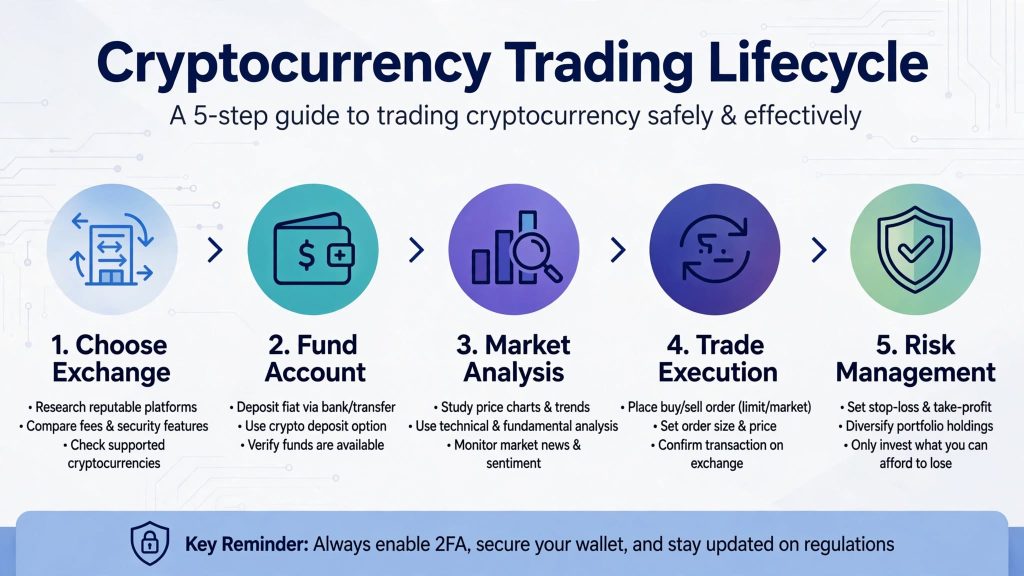
Step 1: Choose the Right Crypto Exchange
The first step in your trading journey is selecting a cryptocurrency exchange. An exchange is a digital marketplace where you can buy, sell, and trade cryptocurrencies. There are two primary types of exchanges: Centralized Exchanges (CEX) and Decentralized Exchanges (DEX).

Centralized exchanges, such as Binance, Coinbase, and Kraken, act as intermediaries. They are user-friendly, offer high liquidity, and allow you to deposit fiat currency (like USD or EUR) directly from your bank account. Decentralized exchanges, like Uniswap or PancakeSwap, operate without a central authority, allowing peer-to-peer trading directly from your crypto wallet.
Here is a quick comparison to help you decide:
| Feature | Centralized Exchanges (CEX) | Decentralized Exchanges (DEX) |
|---|---|---|
| User Interface | Beginner-friendly, intuitive | Steeper learning curve |
| Custody | Exchange holds your private keys | You control your private keys |
| Fiat Deposits | Supported (Bank transfer, credit card) | Not supported (crypto-to-crypto only) |
| Security Risk | Vulnerable to centralized hacks | Vulnerable to smart contract bugs |
| Anonymity | Requires KYC (Identity Verification) | Completely anonymous |
For beginners, a Centralized Exchange is highly recommended due to its simplicity, customer support, and robust security features.
Step 2: Fund Your Account and Secure Your Assets
Once you have created and verified your account on a chosen CEX, you need to deposit funds. Most platforms allow you to link a bank account or use a debit card. Start with a small amount of capital—money you can afford to lose—as the crypto market is notorious for sudden, massive price swings.
As you accumulate crypto, consider transferring your holdings off the exchange into a personal digital wallet. Hardware wallets (cold storage) like Ledger or Trezor keep your private keys completely offline, making them immune to online hacking attempts.
Step 3: Master Market Analysis
Before placing any trades, you must understand why a cryptocurrency's price is moving. Traders generally rely on two main types of analysis:
1. Fundamental Analysis (FA): This involves evaluating the intrinsic value of a cryptocurrency. You look at the project's whitepaper, the development team, the use case, tokenomics (how the token is distributed and used), and overall market adoption. 2. Technical Analysis (TA): This involves studying historical price charts and market data to predict future price movements. Traders use indicators like Moving Averages, the Relative Strength Index (RSI), and Fibonacci retracements to identify trends and entry/exit points.
Successful traders usually employ a combination of both FA and TA to make informed decisions rather than relying on pure speculation or social media hype.
Step 4: Execute Your First Trade
When you are ready to buy or sell, you will encounter different types of orders on the exchange's trading interface. Understanding these is crucial for getting the best price.
- Market Order: This executes your trade immediately at the current best available market price. It guarantees the execution of the order but does not guarantee the exact price.
- Limit Order: This allows you to set a specific price at which you want to buy or sell. The trade will only execute if the market reaches your predetermined price. This offers price control but no guarantee that the trade will actually occur.
Start by using Limit Orders to ensure you do not fall victim to sudden slippage during highly volatile moments.
Step 5: Implement Strict Risk Management
Risk management is what separates successful traders from gamblers. The golden rule of crypto trading is never to risk more than 1% to 2% of your total trading portfolio on a single trade.
Additionally, always utilize Stop-Loss Orders. A stop-loss automatically sells your asset if its price drops to a certain level, capping your potential losses. In a market where a coin can drop 20% in a matter of hours, a well-placed stop-loss is your ultimate safety net.
Conclusion
Trading cryptocurrency can be an exhilarating and profitable endeavor if approached with discipline and education. By choosing a reputable exchange, securing your assets, conducting thorough market analysis, and strictly managing your risk, you can navigate the digital asset market with confidence. Remember, patience is key—take the time to learn, start small, and progressively refine your trading strategies.